

Jakarta – The TNI is currently in the spotlight after the revelation of the alleged corruption case of Basarnas Head Marshal Associate Henri Alfiandi. Finally voices emerged that it was said that the TNI only wanted to occupy civilian positions, but when its soldiers became suspects in common crimes such as corruption, the TNI insisted they did not want to go to civil courts.
The head of the National Search and Rescue Agency or Basarnas is an example of a civilian position occupied by TNI soldiers. And now Air Marshal Henri Alfiandi as Head of Basarnas is being tripped over a case of alleged corruption.
Henri Alfiandi himself has been named by the KPK as a suspect in alleged bribery for the procurement of a number of projects at Basarnas. Henri is suspected of receiving bribes of up to Rp88.3 billion from 2021-2023.
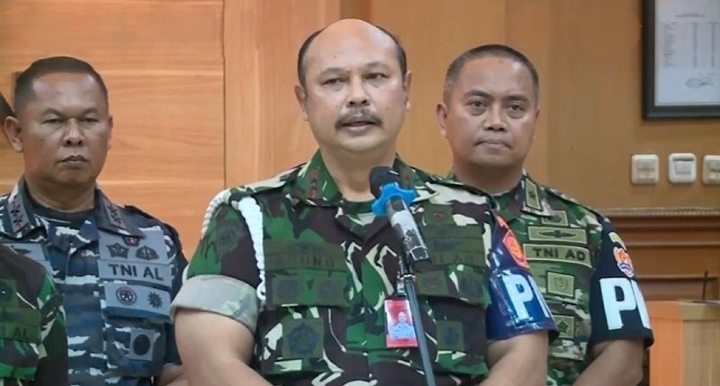
Regarding the assumption that the TNI only wants to occupy civilian positions, but does not want to submit to the rule of civil law, the Commander of the Military Police Center (Danpuspom) TNI Marsda TNI Agung Handoko finally spoke up.
In the Rosi program which was broadcast by Kompas TV on Thursday, (3/8), Marsda TNI Agung Handoko emphasized that all these problems must look again at the rules related to military justice. And the subject of military court law is an active military soldier.
As for the assumption that military justice is for all legal cases, including general crimes, this makes the assessment appear as if the TNI has privilege or impunity.
Marsda TNI Agung Handoko also explicitly denied this assumption. “Actually there is no such thing,” he said.
He further said that in fact there were many legal cases among TNI members who were tried with heavy sentences in military courts. It’s just that, it’s rarely exposed outside the TNI environment. The reason, continued Marsda Agung, is because the mass media has never covered the handling of law within the TNI. Even though the TNI has been open.
“If we look at the problem of corruption in Indonesia, it’s not meant to make a dichotomy between civilians and the military, legal cases with a greater number of civilians. There are only two severe sentences (in the military court). One is a civilian, the other is in the military for life,” he explained.
Even so, he continued, the handling of the case could already be an example when viewed objectively.
“Beyond that, there are a lot of military officers who have been fired just because of various cases,” he explained again.
For your information, Law Number 34 of 2004 concerning the TNI already stipulates that civilian positions can only be occupied by retired or retired soldiers. This is contained in Article 47 paragraph (1).
However, in paragraph (2), the Law on the TNI stipulates that there are a number of civilian positions that are allowed to be filled by active soldiers, namely offices related to state politics and security, defence, military secretary to the president, state intelligence, state code, national security agency, national defense council. , national search and rescue (SAR), national narcotics, and the Supreme Court.
Regarding the legal regulations, Marsda TNI Agung Handoko emphasized that
The TNI is in principle law-abiding and obedient to existing laws.
For example in Article 65 which states that soldiers who violate general criminal acts are tried in general courts. If you violate a military crime, you will be tried in a military court.
“However, many do not read Article 74 in the law. Even though the article states that Article 65 will be enforced if there is a new law on military justice,” he explained.
And he also admits that problems have arisen because there is no new Law on Military Justice. So like it or not we have to use the existing Law on Military Justice. Bembo


