

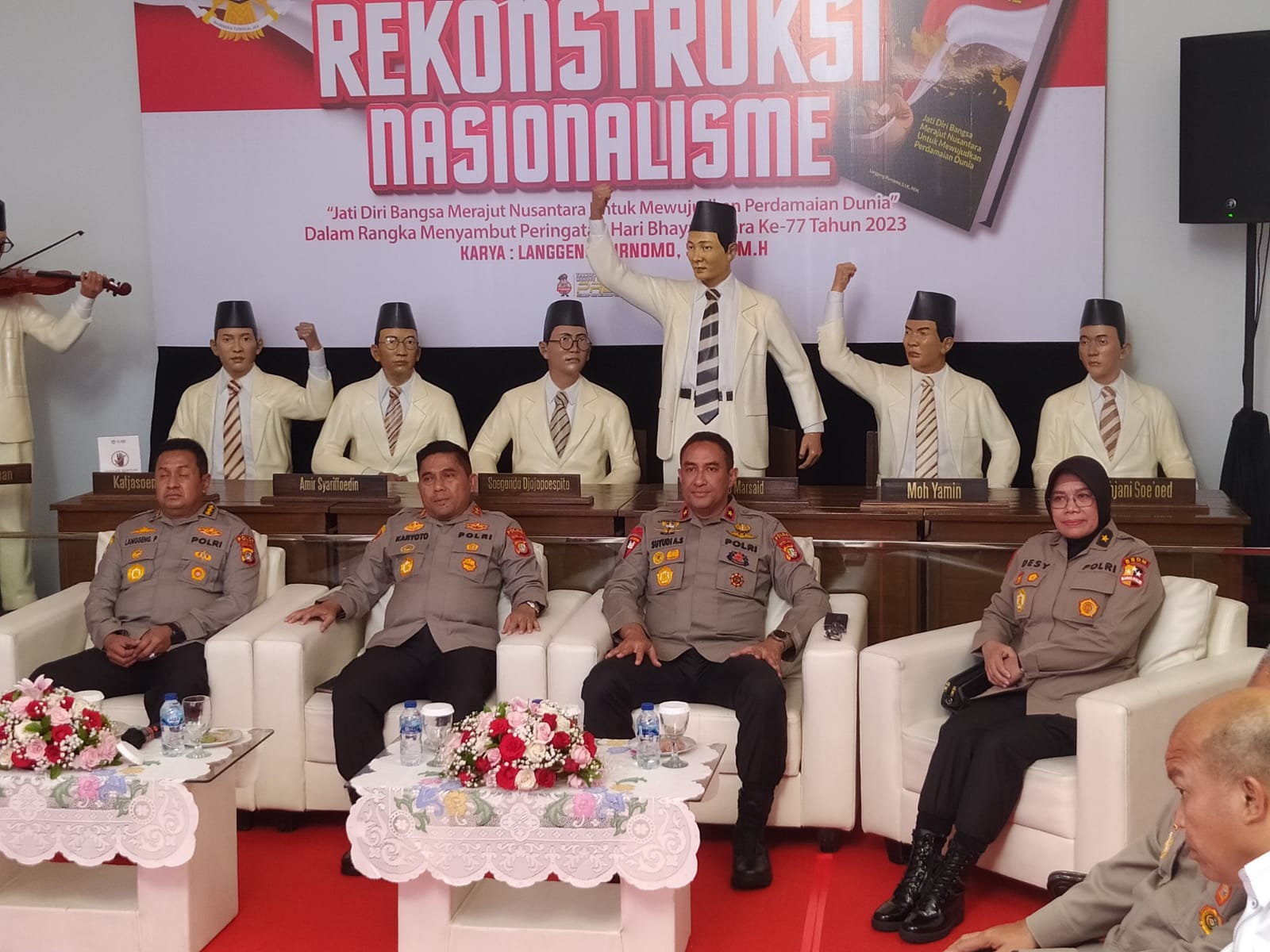
Jakarta – The word reconstruction of nationalism is now starting to surface. And the originator is Kombes Pol Langgeng Purnomo. A middle-ranking police officer with the rank of jasmine three who currently holds the position of HR Karo Polda Metro Jaya.
The word reconstruction of nationalism is lasting in a book entitled “Reconstruction of Nationalism, Nation’s Identity Knitting the Archipelago to Realize World Peace”. This book is the fruit of his reflections on the dynamics and fluctuations of nationalist meanings in society.
In writing in this book, the officer who graduated from the 1995 Patria Tama Battalion of the Police Academy made an understanding to invite all elements of the nation to understand nationalism again with taste and intention. Not just understanding of nationalism that is positivistic, linear, and works like a machine.
Reconstruction of nationalism, according to Langgeng in his book, can be interpreted as an effort to improve the understanding of nationalism in a society that is too rigid and standardized to be flexible by including the heart. It is no longer a rigid understanding that is perpendicular to relying on science and technology as a reference in everyday life.
“A positivistic, linear understanding of nationalism works like a machine. We have to reconstruct it into an understanding of nationalism through taste and intention to protect and preserve the ecosystem of life,” Langgeng said, Thursday (1/6) evening.
Clearly, he said, the reconstruction of nationalism in his book is an invitation from the heart to bring back the true meaning of loving the Indonesian homeland. Especially for parties in society who fail to understand, fail to focus and fail to reason about the Unitary State of the Republic of Indonesia.
Through the media intermediary of this book, Langgeng also invites all elements of society to jointly re-arrange the sacred values of Pancasila, the 1945 Constitution of the Republic of Indonesia, Bhinneka Tunggal Ika, and the Unitary State of the Republic of Indonesia.
And with the use of the reconstructed notion of nationalism, all the differences that exist on this motherland will automatically be seen, assessed, and understood as God’s grace.
“The orderly universe provides an example and teaches us that all of this is something that has been neatly arranged to form a system of many celestial bodies that move in an orderly manner with different functions and roles,” said Langgeng.
“Each will be in its orbit and will not collide with each other. On the other hand, night forms an order in the universe,” he added.
The parable, Langgeng continued, just needs to be synchronized with the understanding of Bhinneka Tunggal Ika in Indonesian society. If our body is likened to being made up of various organs and shapes, all of them will still carry out their functional duties as a system to enable us to live fully as human beings who can move.
Likewise with the diversity of Bhinneka Tunggal Ika in the Republic of Indonesia. It is a necessity that the differences that exist are a blessing for all of us. If we can react to it like the order of the universe, then grace can bring peace to this life.
“Once again, through this book, I would like to invite all elements of the nation for national repentance to return to our national identity. We will all return to the Creator, Allah SWT, God Almighty,” said Langgeng.
“That’s why, before returning, I want to invite everyone to be able to apply Pancasila in concrete actions to solve various humanitarian problems for the sake of world peace. And in this book I call it the way of loving the motherland,” continued the man who was born in Kebumen, June 15, 1972 ending his statement. Bembo


