

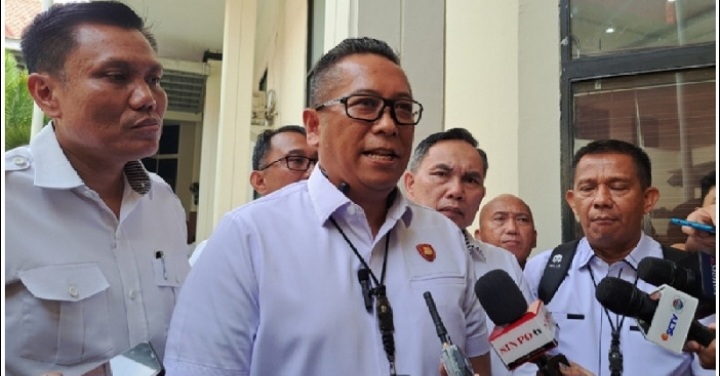
Jakarta – The panic of the inactive Chairman of the Corruption Eradication Commission (KPK), Firli Bahuri, in the pre-trial hearing against the Kapolda Metro Jaya, Irjen Pol Karyoto, is becoming increasingly clear. During the trial, Firli tried to attack Irjen Pol Karyoto with a sack of evidence that had no connection with the trial material.
This strange step made the Head of Legal Affairs of Polda Metro Jaya, Kombes Pol Putu Putera Sadana, confused. He wondered why someone of Firli’s class could be so confident in bringing evidence that was not related to the alleged extortion case of former Minister of Agriculture Syahrul Yasin Limpo (SYL) which made him a suspect.
Kombes Pol Putu questioned Firli Bahuri’s lawyer, Ian Iskandar, who brought documentary evidence regarding the handling of the alleged bribery case of former officials from the Directorate General of Railways (DJKA) of the Ministry of Transportation in the pre-trial hearing. Even though this evidence is not relevant to the alleged corruption case that made Firli a suspect. Apart from that, the evidence brought is also confidential. However, Firli’s attorney, the confidential nature of the evidence was changed to open during the trial.
“There are several documents used as evidence and we already have 159 pieces of evidence which will of course be tested at the main case hearing, not pre-trial. However, the applicant (Firli Bahuri) submitted evidence which in our opinion has no correlation with what was being discussed at the pre-trial hearing. Exhibits P26 to P37,” explained Kombes Pol Putu in a pre-trial hearing at the South Jakarta District Court, last Friday, (15/12).
“I read for example, P26 the attendance list and conclusions and so on regarding OTT DJKA. This is evidence which in our opinion is not linear with what we are discussing. Because the petitum in question is one of which is that the suspect’s determination is invalid,” he continued representing the Kapolda Metro Jaya, Irjen Pol Karyoto.
To make it clearer, more transparent and logical, Kombes Pol Putu also presented criminal law expert witnesses in the trial. The first is criminal law expert from Brawijaya University, Fachrizal Afandi. To Fachrizal, Kombes Pol Putu asked whether the documents submitted by Firli were documents that needed to be kept secret or not.
“Is this document a state document that needs to be kept secret or not? Because it is kept secret in the police, not to mention P37. Almost everything about the DJKA is made into powder here. We ask what is the correlation with the case we are discussing?” asked Kombes Pol Putu.
Fachrizal Afandi answered this question by asking again whether the documents for handling the DJKA case were obtained legally or not. If it’s legal then it’s not a problem.
“First, what we have to look at is what the evidence is like. Is the evidence general in nature, for example names that we can access widely in the media or the KPK database that can be accessed publicly. But, for example, if the evidence revealed at the trial is an ordinary person It’s hard to get it, so we have to see what its relevance is to this case,” explained Fachrizal.
“Information that can hinder the investigation and investigation process of a criminal act, for example revealing the identity of information, reporters, witnesses or victims who are aware of a criminal act, or for example disclosing criminal intelligence data, and which is related to the prevention and handling of criminal acts, we can see that. The process is confidential, excluded from public information,” he continued in his explanation.
He also explained that anyone who accesses, obtains and/or provides excluded information can be subject to a maximum penalty of 2 years in prison. He also said that there was a threat of a maximum fine of Rp10 million as regulated in Article 54 of the Public Information Openness Law (KIP).
“But, again, if we talk about criminal acts, we have to look at the mens rea (evil intent) and actus reus,” said Fachrizal at the end of his explanation.
In line with Fachrizal, Lecturer at the Faculty of Law, University of Indonesia (UI) Junaedi Saibih, who was also presented as an expert, said that Firli’s lawyer’s actions in bringing documentary evidence in the DJKA case were inappropriate. The reason is that it is not in accordance with the material used as pretrial.
“This pretrial should be related to the process of formally determining the suspect, for example how the summons was carried out,” explained Junaedi.
“As for confidential documents, they should not be disclosed because there is the potential for something dangerous to happen in the investigation process.”
“For example, the person’s information is related to examinations and so on. Then there are concerns that it will become an obstacle to the investigation process. For example, the person might run away,” emphasized Junaedi. Bembo


